


Inquiry Basket
 Loading ......
Cysteine proteases are proteolytic enzymes, the catalytic active center of which is defined by a cysteine residue. Cysteine proteases are present in a wide range of organisms, from viruses to humans. They are involved in many cellular functions, from protein homeostasis, signal transduction and apoptosis to inflammatory and immune processes. Abnormalities in cysteine protease activity have a direct relationship with several major diseases, such as cancer, neurodegeneration, inflammation and viral infection.
The hallmark of cysteine proteases is the presence of the thiol group (-SH) of a cysteine residue as part of the catalytic active center. In this reaction, the thiol acts as a nucleophile and attacks the carbonyl carbon of the peptide bond in the substrate protein.
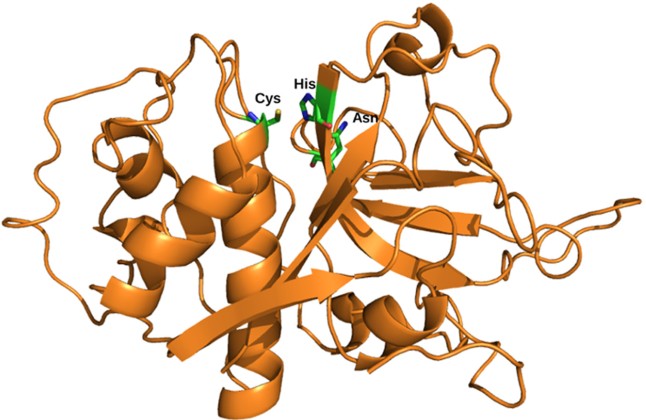 Figure 1. Structure of the mature domain. (Source: Verma S, et al. 2016)
This database classifies proteases into different Families and Clans based on sequence homology, three-dimensional structure, and evolutionary relationships.
Clan
Represents a group of families with a shared evolutionary origin, serving as a higher-level taxonomic unit. In the MEROPS database, clans for cysteine proteases are prefixed with the letter 'C' (e.g., CA, CD).
Family
A unit within a clan, defined by closer sequence similarity. Families are named with the catalytic type letter followed by a number (e.g., C1, C2, C14).
| Family | Clan | MEROPS | Representative Members | Catalytic Core/Mechanism | Biological Function |
| Papain-like Proteases | CA | C1 |
| Catalytic Triad:
| Protein degradation; Primarily function as cathepsins in mammals |
| Caspase Family | CD | C14 | Caspase family members | Specifically cleaves peptide bonds after Asp residues | Core regulators of Apoptosis (programmed cell death) |
| Legumain Family | CD | C13 | Asparaginyl Endopeptidases (AEPs) | - | Antigen presentation in lysosomes; Associated with tumor invasion and metastasis |
| Calpain Family | CA | C2 | Calpain family members | Calcium ion-dependent | Limited proteolysis to regulate target protein activity; Cell signaling; Cytoskeletal remodeling; Cell cycle progression |
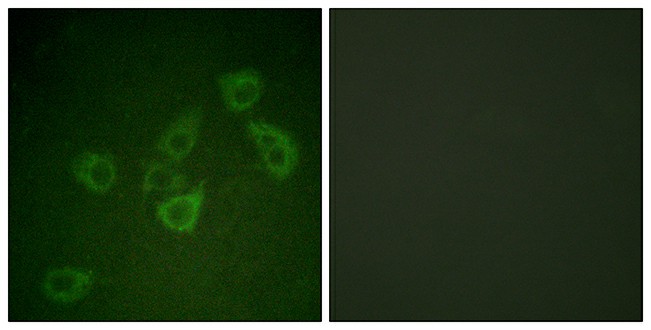
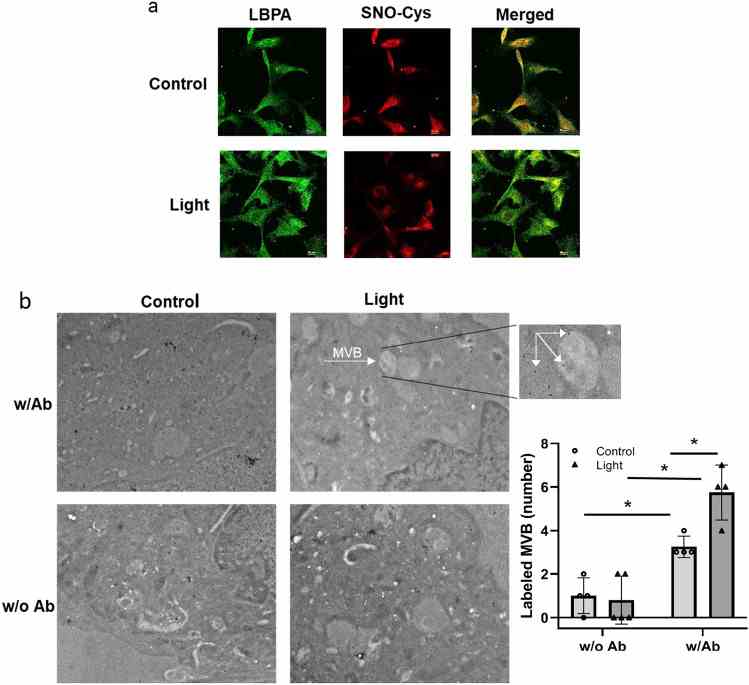 Figure 2. Accumulation of RSNO in Multi Vesicular Body. AECs were exposed to 670 nm light (6 J/cm2)
Applications: ICC
Reactive species: Unspecified reactive species
"S-Nitrosocysteine (Cys-SNO) antibody was Creative Diagnostics (Shirley, NY) product."
Weihrauch D, Keszler A, Broeckel G, Aranda E, Lindemer B, Lohr NL. Red light mediates the exocytosis of vasodilatory vesicles from cultured endothelial cells: a cellular, and ex vivo murine model. Photochem Photobiol Sci. 2024 Feb;23(2):355-364.

Kim DCABH-140
Excellent Product
Myrmel DCABH-14860
The feeling of use is amazing!
Wen DCABH-7514
It was amazing
Alenichev DCABH-3401
Give this CAPN2 antibody a good review
The catalytic mechanism of cysteine proteases has been studied in great detail. Central to its mechanism is the synergistic action of a catalytic triad (or dyad). Using the archetypal papain-like proteases as an example, a general catalytic mechanism is as follows:
Activation of active site: The imidazole ring of Histidine (His) in the catalytic triad (Cys, His, Asn) functions as a general base, abstracting the proton from the thiol group (-SH) of the cysteine (Cys). The asparagine (Asn) forms hydrogen bond network with the protonated His imidazolium ring which then can accept the proton better. The increase in nucleophilicity of the Cys thiolate due to loss of proton results in formation of a highly reactive thiolate-imidazolium ion pair.
Nucleophilic attack, tetrahedral intermediate formation: The activated Cys thiolate anion attacks the carbonyl carbon of the substrate's peptide bond, forming an unstable, negatively charged covalent tetrahedral intermediate. The negative charge of this intermediate is stabilized by a structure in the active site known as the "oxyanion hole".
Acyl-Enzyme Intermediate Formation: The tetrahedral intermediate collapses. The protonated histidine now acts as a general acid and donates its proton to the amino group of the scissile peptide bond. The protonated amino group leaves and the cleavage of the peptide bond liberates the C-terminal half of the product, with concomitant formation of a covalent acyl-enzyme intermediate between enzyme and the N-terminal part of the substrate.
It is noteworthy that not all cysteine proteases rely on a complete triad. For instance, some viral proteases may utilize a catalytic dyad (Cys-His) to accomplish catalysis.
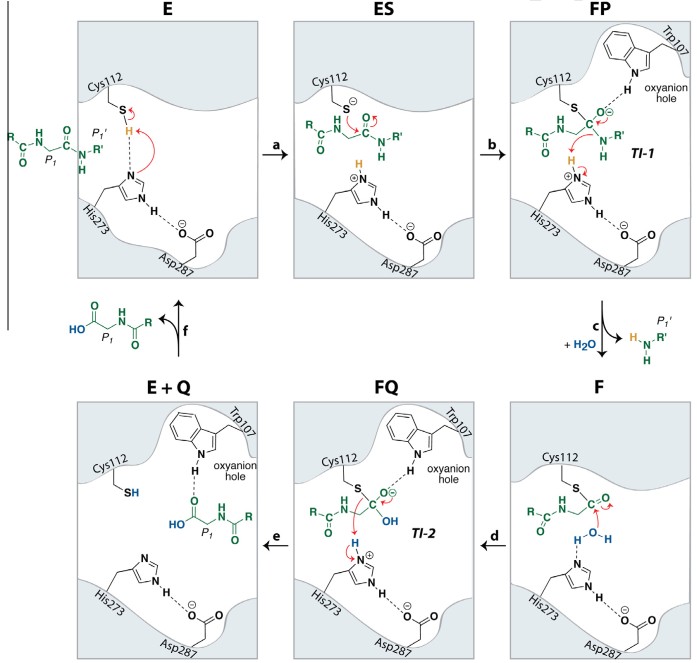 Figure 3. Catalytic cycle and proposed chemical mechanism of the SARS-CoV PLpro catalyzed reaction. (Source: Báez-Santos YM, et al. 2015)
The functions of cysteine proteases are remarkably diverse, playing roles across the spectrum of health and disease.
Part 01
Cathepsins
Traditionally viewed as "housekeeping" enzymes within lysosomes, responsible for degrading obsolete intracellular and extracellular proteins and phagocytosed material.
They may be secreted extracellularly to be involved in extracellular matrix remodeling, which is involved in osteoarthritis, osteoporosis and cancer metastasis. In the immune system, they cleave foreign antigens of APCs to form peptides that can be loaded on MHC class II molecules, essential for initiating the adaptive immune response.
Part 02
Caspases
These are the core executioners of the apoptotic signaling pathway. They exist as inactive zymogens and, upon receiving an apoptotic signal, become sequentially activated through a cascade. Activated caspases specifically cleave a variety of key intracellular proteins, such as nuclear lamins and DNA repair enzymes, ultimately leading to the orderly, programmed death of the cell without triggering an inflammatory response.
Part 03
Calpains
Functioning as signal transduction molecules, calpains do not completely degrade their substrates but a specific "trimming" is performed that alters the function or location of the target protein. By cleaving cytoskeletal proteins, calpains are important for cell migration and changes in cell shape; by cleaving kinases or phosphatases, calpains can modulate complex signaling cascades. Increased calpain activity has been associated with muscular dystrophy, neurodegenerative disease and ischemic damage.
Part 04
Legumain
In immune response, legumain has been shown to be involved in antigen processing in lysosomes and endosomes. Legumain has become increasingly recognized as a tumor-associated protease in recent years. Legumain is overexpressed in a number of cancers and has the ability to relocate from lysosomes to the cell surface. It becomes more active in the acidic tumor microenvironment and can activate a number of other proteases (including matrix metalloproteinases) and this leads to a joint contribution to tumor invasion and angiogenesis.
Part 04
Viral Cysteine Proteases
A number of viruses, especially RNA viruses, have one or more cysteine proteases encoded in their genome. Viral cysteine proteases play a crucial role in viral replication by cleaving the long polyprotein precursor, that is translated from the viral genome, into a number of mature proteins with different functions. Therefore, they are an ideal target for antiviral drugs, as their inhibition completely blocks the viral life cycle.
References
Loading ......
