ASM Microbe 2026
June 4-7, 2026 – Washington, DC, USA
ADLM 2026
July 26-30, 2026 – Anaheim, CA, USA

Competitive ELISA Protocol

Introduction of Competitive ELISA Protocol

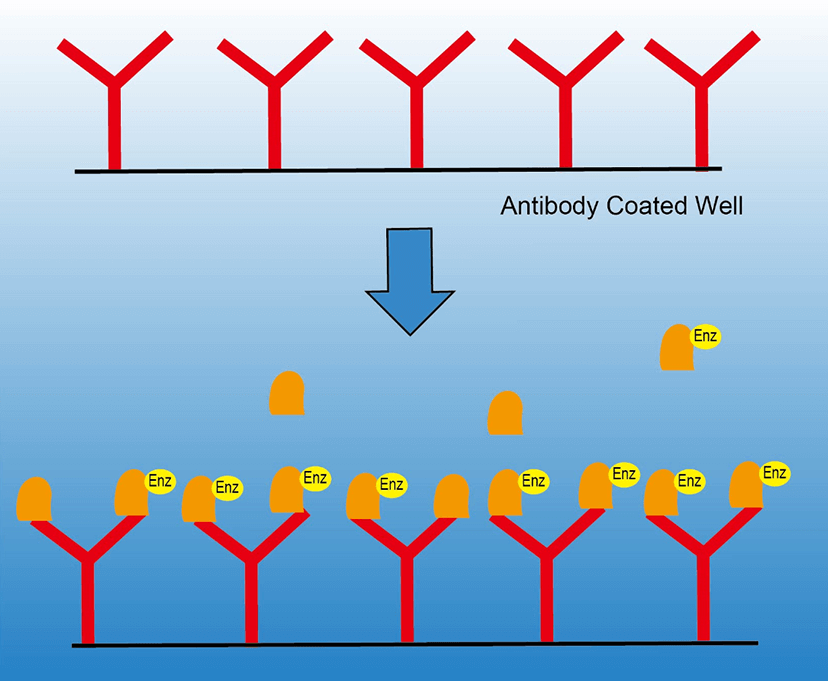
ELISA is a highly sensitive test technique based on immunological reactions that combine the specific reaction of antigens and antibodies with the efficient catalytic action of enzymes on substrates. Since the reaction of the antigen and the antibody is carried out in the well of a solid phase carrier-polystyrene microtiter plate, after each reagent is added, the excess free reactant can be removed by washing to ensure the specificity and stability of the test result. In ELISA, competition ELISAs are particularly useful for measurements of antigen concentration in complex mixtures when the unknown samples that may contain antigen are compared to similar samples that contain known amounts of purified antigen.
Browse All ELISA Kit Products

Competitive ELISA ProtocolFigure 1. Diagram of a competitive binding assay.

Reagent of Competitive ELISA Protocol

Equipment of Competitive ELISA Protocol

  • Polystyrene plastic plate (referred to as microplate) 40 holes or 96 holes.
  • ELISA detector.
  • Incubators.

Procedures of Competitive ELISA Protocol

  1. Coat microtiter plate wells with 100 μl of the antigen solution, at a concentration of between 1-10 μg/ml in coating buffer. Cover the plate with adhesive plastic and incubate overnight at 4°C. Remove the coating solution and wash the plate thrice by filling the wells with 200 μL PBS. The solutions or washes are removed by flicking the plate over a sink. The remaining drops are removed by patting the plate on a paper towel.
  2. Block the remaining protein-binding sites in the coated wells by adding 200 μL blocking buffer (5% non-fat dry milk or BSA/PBS) per well. Incubate for 1 hour at 37°C or overnight at 4°C. Wash 3 times in wash buffer.
  3. Prepare the antigen antibody mixture by adding 50 μl of antigen to 50 μl of antibody for each well in the assay (use a range of antigen concentrations appropriately diluted in wash buffer). Incubate for 1 hour at 37°C.
  4. Add 100 μl of the mixture to each well. Incubate for 90 min at 37°C. Wash 3 times in wash buffer.
  5. Add 100 μl enzyme-conjugated secondary antibody (appropriately diluted in wash buffer) to each well. Incubate for 1 hour at 37°C. Wash 3 times in wash buffer.
  6. Add 100 μL of TMB Microwell Substrate solution to each well (substrate solution should be at RT prior to use).
  7. The estimated incubation times for the enzyme-substrate reaction range from 20 to 30 minutes. Add 50 μl of stop solution. After stopping the enzymatic reaction the plate should be read at 450 nm.

Or

  1. 50 μL of diluted primary antibody (capture) is added to each microtiter well. Incubated for 4 h at room temperature or 4°C overnight.
  2. Wells are washed twice with PBS. The antibody solution washes can be removed by flicking the plate over a suitable container.
  3. Block the remaining protein-binding sites in the coated wells by adding 200 μL blocking buffer (5% non-fat dry milk or BSA/PBS) per well. Incubate for 1 hour at 37°C or overnight at 4°C. Wash 3 times in wash buffer.
  4. 50 μL of standards (enzyme labeled) or sample solution are added to wells. All dilutions should be done in blocking buffer.
  5. 50 μL of the antigen (enzyme labeled) is added to wells (antigen solution should be titrated). All dilutions should be done in blocking buffer & incubated for at least 2 h at room temperature.
  6. Plate was washed with PBS for four to five times.
  7. Substrate is added. After suggested incubation time has elapsed, optical densities at target wavelengths can be measured on an ELISA reader.
  8. Analysis of data: One group of enzyme-labeled antigen and the tested antigen mixture, the other group only added enzyme-labeled antigen, after incubation and washing, adding substrate color, the difference between the degradation of the two groups of substrates, that is, the amount of unknown antigen to be determined.
Inquiry Basket