
 Anti-Cytotoxic Payloads Antibodies

Inquiry Basket
 Loading ......
Antibody-drug conjugates (ADCs) are a class of conjugated monoclonal antibodies that covalent bind cytotoxic small molecule compounds through a conjugated arm, enhancing the targeting of traditional anti-tumor small molecule drugs and reducing toxic side effects. Due to the heterogeneity of ADCs structure and the dynamic variation of drug-to-antibody ratio (DAR) in vivo, the biological analysis of ADCs faces great challenges. Pharmacokinetics (PK) is the material basis for interpreting drug efficacy and safety, and its importance is beyond doubt. Another problem is the evaluation of anti-therapeutic antibody (ATA), which may have a significant impact on the results of pharmacokinetic studies.
ADCs are actually mixtures, antibodies in ADCs are covalently linked to small molecule drugs by a linker, which can bind to the amino lysine side chain of the antibody, or to the sulfhydryl group resulting from the reduction of disulfide bonds between antibody chains, or to engineered cysteine residues introduced at specific sites on the antibody1-3.
ADCs are theoretically stable in plasma, but the linker can still break down under special circumstances, allowing small molecule drugs to dissociate. The dissociation of small molecule drugs can change the DAR value or present a new DAR value. Studies have shown that the clearance rate of ADCs increases with DAR values4.
For small molecule drugs and protein drugs, the exposure-response (ER) can be known by measuring the original drug. However, ADCs contain both antibody and small molecule drug components, and DAR values in vivo change dynamically, as well as limited clinical data, so it is difficult to determine which substance to be measured affects ER. In general, in the early stages of ADCs development, as many substances as possible are tested to understand the pharmacokinetic characteristics of each component of the ADCs. These tests generally include total antibodies, ADCs and free small molecule drugs. In addition, anti-therapeutic antibodies (ATAs) may be produced when ADCs enter the body. ATAs may reduce the efficacy of ADCs, so it is necessary to evaluate ATAs during the development of ADCs.
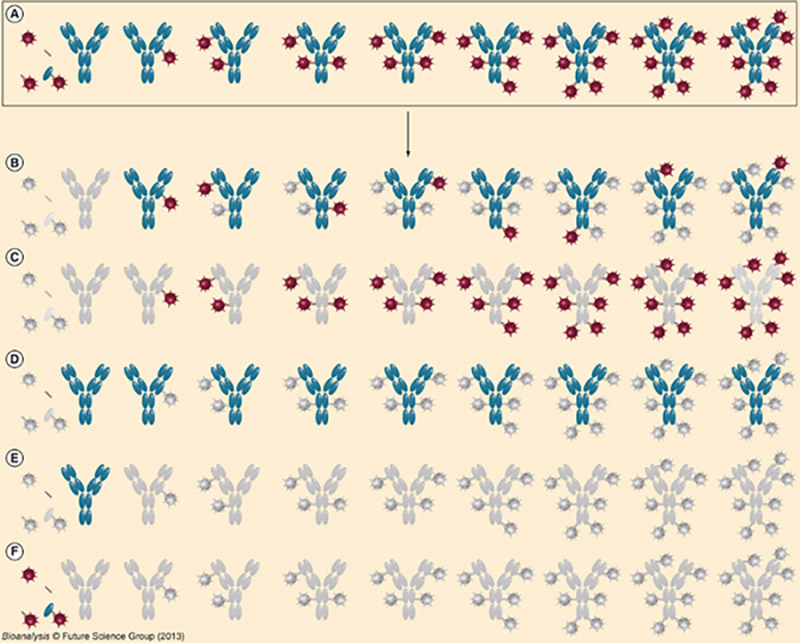 Fig.2 Antibody–drug conjugate analytes.(Kaur, S.; et al. 2013)
DAR analysis includes two aspects:
The most commonly used methods are spectrometry, High performance liquid chromatography-ultraviolet (HPLC-UV) and mass spectrometry.
Indirect-ELISA: The coated antigen was used to capture the total antibody, and the second antibody was used as the detection antibody according to the species property of the total antibody5. This method has the advantages of extensive application and mature technology, but sometimes it is difficult to obtain commercial antigen.
ECLA: ECLA uses electrochemiluminescence techniques with higher sensitivity and a wider dynamic range to obtain signals. One example is the highly sensitive MSD instrument developed by Meso Scale Diagnostics, inc.
Conjugated antibodies are those that bind to small molecule drugs and have DAR≥1. The determination of conjugated antibody is mostly by ELISA.
Bridge-linked ELISA: Based on the high specificity and amplification effect of the binding between biotin and avidin or streptavidin (one molecule of avidin or streptavidin can bind four molecules of biotin), bridge-linked ELISA method can be designed to amplify the detection signal.
For the determination of the toxin molecules linked to the antibody, the ADC is usually separated from the free small molecule toxin in some way, and then the small molecule toxin is released by chemical reaction or enzyme stimulation, and finally the accurate quantitative results are obtained by ELISA or LC-MS/MS.
ELISA: Anti-ID antibody, antigen ECD or anti-human IgG antibody were selected to capture the antibody part of an ADC, and anti-small molecule drug antibody was used as detection reagent.
LC-MS/MS: The conjugated antibody is first captured with reagents (such as protein A, anti-ID antibody, antigen, etc.), followed by the removal of the connecting arm, and finally, LC-MS /MS analysis is performed for the small molecule drugs.
The free small molecule drug is the part of the drug that has been dissociated from the antibody, and it can be determined by competitive-ELISA7 and LC-MS/MS8.
Competitive-ELISA: For the determination of free DM1, the sample was first precipitated by acetonitrile, the supernatant containing free DM1 was mixed with biotinylated mouse anti-DM1 antibody, and then transferred to a plate coated with BSA-DM1. DM1 in the sample will competitively bind anti-DM1 antibody with coated BSA-DM1. The higher the concentration of DM1 in the sample, the less DM1 antibody bound by BSA-DM1, and the lower the signal detected by streptavidin-HRP.
For the ATA of an ADC, the binding epitope may be one of the three components of the ADC or a combination of the three components. ATA is usually analyzed by LBA, and the capturing reagent is usually a solid-phase ADC, which can theoretically capture all ATA targeted at different antigen epitopes. The analysis was generally divided into two steps.
A variety of analytical techniques can be used to detect ATA, such as ELISA, bridging ELISA, ECLA, radioimmunoprecipitation (RIP), surface plasmon resonance (SPR), etc. Each method has its own advantages and disadvantages.

References
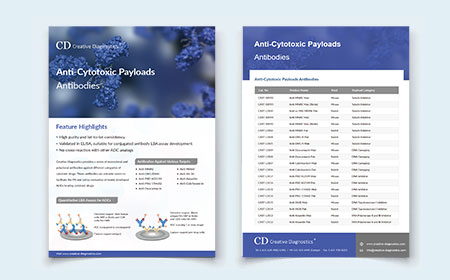
Creative Diagnostics has developed anti-MMAE antibodies and paired conjugates that are suitable for ADC ELISA assay development. It can be used in the quantitative determination of ADC level in test sample, thereby greatly saving the time and costs.
| Cat. No | Product Name | |
| CABT-B8992 | Anti-MMAE monoclonal antibody, clone 3F3 | Inquiry |
| CABT-B8993 | Anti-MMAE monoclonal antibody, clone 3F3 [Biotin] | Inquiry |
| Cat. No | Product Name | Host | Payload Category | |
| CABT-B8992 | Anti-MMAE Mab | Mouse | Tubulin Inhibitor | Inquiry |
| CABT-B8993 | Anti-MMAE Mab [Biotin] | Mouse | Tubulin Inhibitor | Inquiry |
| CABT-L3100 | Anti-vc-PAB-MMAE Pab | Rabbit | Tubulin Inhibitor | Inquiry |
| CABT-B8994 | Anti-MMAF Mab | Mouse | Tubulin Inhibitor | Inquiry |
| CABT-B8995 | Anti-MMAF Mab [Biotin] | Mouse | Tubulin Inhibitor | Inquiry |
| CABT-L3102 | Anti-MMAF Pab | Rabbit | Tubulin Inhibitor | Inquiry |
| CABT-L3104 | Anti-DM1/4 Pab | Rabbit | Tubulin Inhibitor | Inquiry |
| CABT-L3105 | Anti-DM1/4 Mab | Mouse | Tubulin Inhibitor | Inquiry |
| CABT-L3109 | Anti-Duocarmycin Mab | Mouse | DNA Damaging | Inquiry |
| CABT-L3108 | Anti-Duocarmycin Pab | Rabbit | DNA Damaging | Inquiry |
| CABT-L3107 | Anti-Calicheamicin Mab | Mouse | DNA Damaging | Inquiry |
| CABT-L3106 | Anti-Calicheamicin Pab | Rabbit | DNA Damaging | Inquiry |
| CABT-L3117 | Anti-PBD SG3199 Mab | Mouse | DNA Inhibitor | Inquiry |
| CABT-L3116 | Anti-PBD SG3199 Pab | Rabbit | DNA Inhibitor | Inquiry |
| CABT-L3111 | Anti-PNU-159682 Mab | Mouse | DNA Inhibitor | Inquiry |
| CABT-L3110 | Anti-PNU-159682 Pab | Rabbit | DNA Inhibitor | Inquiry |
| CABT-L3115 | Anti-SN38 Mab | Mouse | DNA Topoisomerase I Inhibitor | Inquiry |
| CABT-L3114 | Anti-SN38 Pab | Rabbit | DNA Topoisomerase I Inhibitor | Inquiry |
| CABT-L3113 | Anti-Amanitin Mab | Mouse | RNA Polymerase II and III Inhibitor | Inquiry |
| CABT-L3112 | Anti-Amanitin Pab | Rabbit | RNA Polymerase II and III Inhibitor | Inquiry |
Creative Diagnostics provides a series of monoclonal and polyclonal antibodies against different categories of cytotoxic drugs. These anti-drug antibodies will be valuable assets to facilitate the PK and safety evaluation of newly developed ADCs bearing these drugs.
| Cat. No | Product Name | Method | |
| DEIABL312 | MMAE ADC EIA Kit | Competitive ELISA | Inquiry |
| DEIABL314 | Intact MMAE ADC ELISA Kit | Sandwich ELISA | Inquiry |
| DEIABL311 | DM1 ADC ELISA Kit | Competitive ELISA | Inquiry |
| DEIABL313 | MMAF ADC EIA Kit | Competitive ELISA | Inquiry |
| DEIABL315 | Intact MMAF ADC ELISA Kit | Sandwich ELISA | Inquiry |
Creative Diagnostics provides a serial of ELISA kits for 32 biological drugs monitoring. Production is carried out in accordance with ISO13485 quality management system and with expert scientists. After each production, quality control experiments are carried out by expert and experienced scientists in line with CLSI and FDA directives. View More
Loading ......
