



Inquiry Basket
 Loading ......
IF is a potent tool in cell biology to see where and when certain proteins or other molecules exist in cell or tissue sections. This technique uses antibodies linked to fluorescent dyes to attach to and illuminate specific antigens revealing the crucial details about how cells work, structure and signaling are going on. But the big secret to immunofluorescence tests’ success is a matter of antibodies. In this one stop guide, we’ll explain everything you need to know about getting the right antibodies for immunofluorescence for the best results and reproducibility.
In addition, Creative Diagnostics also offer high quality fluorescent conjugates secondary antibody products:
The foundation of any successful immunofluorescence experiment lies in a thorough understanding of the target protein. This knowledge guides the selection of the most suitable antibody for your specific needs.
First find out which gene coded your protein of interest. All this tells us something about the function and functioning of the protein inside the cell. For example, is it an enzyme, a receptor, a structure or in signaling pathways?
Using the number of copies of the target protein. Low-lying proteins might need to be targeted by very sensitive polyclonal antibodies or monoclonal antibodies of high affinity.

Knowing what your protein’s structures are will help to select antibodies.
Determine where the protein is located in the cell. Is it nuclear, cytoplasmic, membrane-bound or released? This information is essential when deciding on the right antibody and structuring your cell preparation and staining steps.
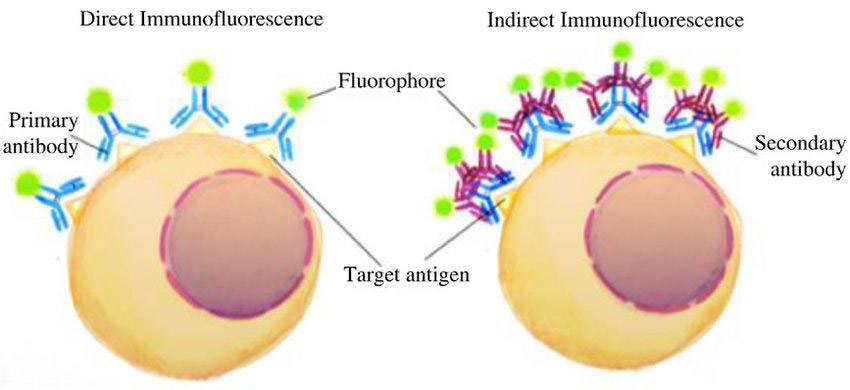
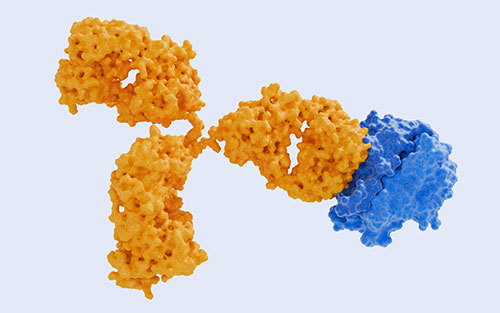
A major immunofluorescence decision is whether to use primary antibodies directly labeled or primary plus secondary antibodies.
| Type | Description | Advantages | Disadvantages |
| Primary Antibodies | Bind directly and specifically to antigens. Can be monoclonal or polyclonal. | Monoclonal: High specificity, reproducibility, minimal nonspecific binding, low background staining. Polyclonal: Higher sensitivity, can detect low protein levels, tolerance for minor protein conformational differences. | Monoclonal: Can only target one epitope. Polyclonal: Can result in variability, cross-reactivity with other proteins. |
| Secondary Antibodies | Bind to the host species of the primary antibody, conjugated to fluorophores for visualization. | Provides signal amplification, flexible (same secondary for different primary antibodies), enhanced fluorescence signal. | Can introduce additional steps, nonspecific binding, background staining. Requires optimization of concentrations and washing. |
Achieving precise and specific staining requires antibodies that have the right species reactivity and host species.


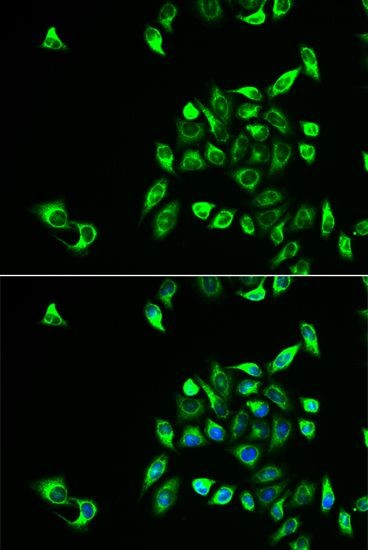
Green fluorophore. FITC is cheap, easily bleached, and not recommended for long-term imaging.
Cyanine dyes (Cy3 and Cy5) work well for long-term imaging. Resistant to photobleaching; allows for multicolor imaging.
Alexa Fluor dyes are light and photobleach resistant in multiple colors. They lend themselves well to multiplexing experiments as they don’t have that much overlap.
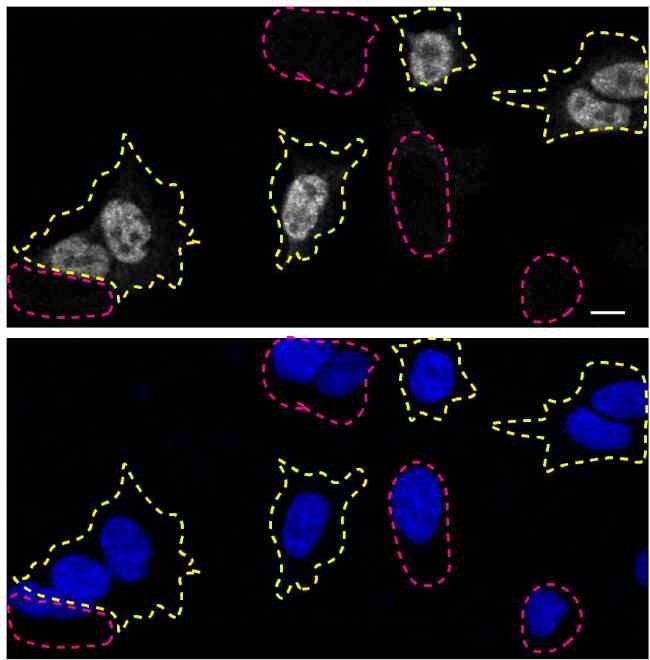
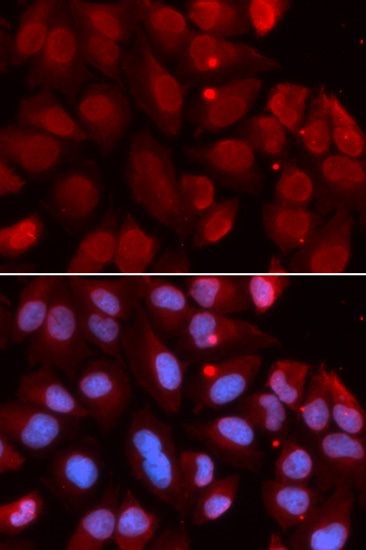
A nuclear dye that binds to DNA and emits blue light.

Select fluorophores with excitation and emission spectra compatible with your fluorescence microscope filter sets. Be sure not to have spectral overlapping for crosstalk between channels.
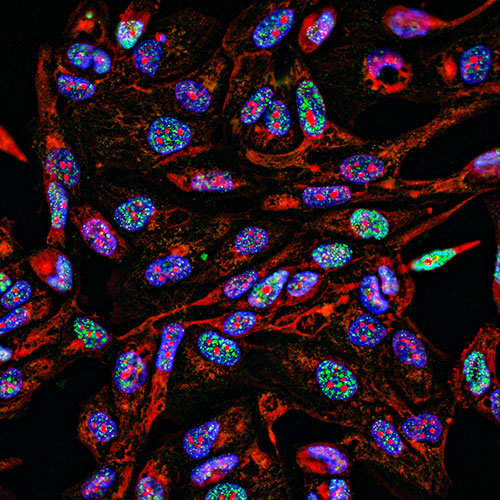
When you’re multiplexing, choose fluorophores with contrasting emission bands so that the signals are not obstructed.
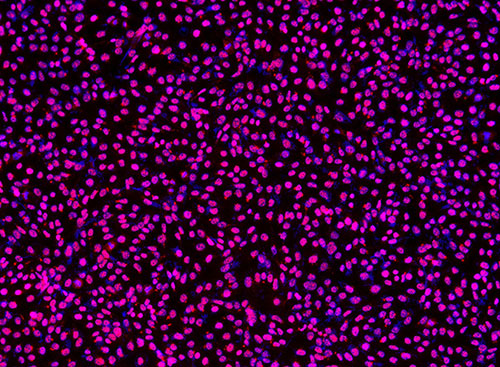
Consider the fluorophore photostability (eg, for long-term imaging or live-cell imaging). The more photostable the fluorophore, the less the signal will be masked as time goes on and data will be recorded in confidence.
Determine the best dilution and incubation times for your antibodies. Manufacturers typically provide suggested dilutions but you might need to a little more optimization depending on your use case. In too high a concentration we have strong background, in too low a concentration no signal.
| Type of Control | Description | Purpose | |
Negative Controls | No Primary Antibody Control | Incubate the sample only with the secondary antibody, no primary antibody. | Detects nonspecific interaction with the secondary antibody. |
| Unirrelevant Primary Antibody Control | Use a primary antibody that does not recognize the antigen in the sample. | Identifies nonspecific binding of the primary antibody. | |
Positive Controls | Positive Sample Known to Have Target Protein | Provide a sample that has already expressed the target protein. | Confirms the staining method is correct and the antibody can recognize the target antigen. |
| Internal Positive Control | Include regions or structures in the experimental sample that are known to express the target protein. | Serves as an internal confirmation that the target protein can be detected within the sample. | |
| Isotype Control | Use the same isotype but non-target specific antibody. | Detects nonspecific binding due to the antibody isotype. | |
Once you are more accustomed to immunofluorescence, additional tips and tricks can make your experiments even more targeted and data more reliable.
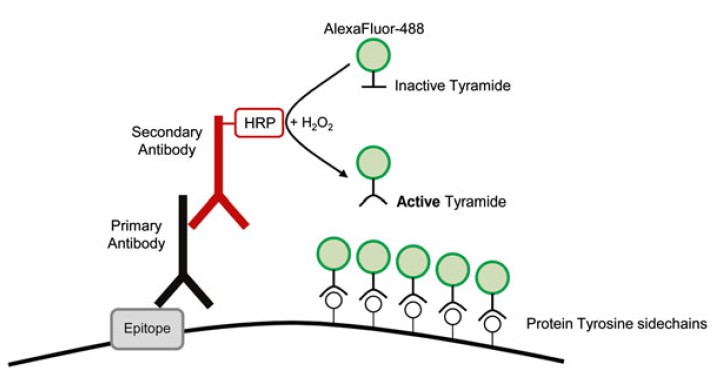
If you have low abundance proteins or want more signal, consider signal amplification with tyramide signal amplification (TSA) or biotin-streptavidin platforms. We can also employ them to enhance fluorescence signal and therefore target antigens detection with higher precision.
Many different targets can be elicited in one sample. This approach is useful for the investigation of intricate cell behaviour and protein co-localisation. Multiplexing takes the correct fluorophore and spectral unmixing algorithm.
Subcellular structures can be studied more accurately by using super-resolution microscopy.
The live-cell imaging allows you to watch living processes going on. Choose antibodies and fluorophores that are appropriate for live-cell use (with a minimum of phototoxicity and cell death). For live-cell research, fluorescent proteins like GFP (green fluorescent protein) or mCherry can be genetically engineered.
| Possible issues | Solutions |
| Wrong excitation wavelength | Make sure the excitation wavelength matches the fluorophore excitation wavelength |
| Incompatible primary or secondary antibodies | Pay attention to species issues |
| Over- or under-fixation | Adjust the time appropriately |
| Improper sample storage | Avoid light |
| The primary antibody is not effective | It is recommended to perform a positive control to confirm the effectiveness of the antibody |
| Possible issues | Solutions |
| Insufficient washing | Wash thoroughly and increase the number of washes appropriately |
| Sample drying | Incubate antibodies in a humid chamber to prevent samples from drying out |
| Insufficient closure | Extend the time or change the blocking solution |
| Antibody concentration is too high | Preliminary titration to confirm the optimal concentration |
| Non-specific binding of secondary antibody | No primary antibody was added, only secondary antibody was added as control |
| Sample autofluorescence | Detect sample autofluorescence in advance |
Possible Problem Solutions Tissue sections fall off the slide or there are bubbles in the sections. Properly increase the fixation time. Tissue sections are torn or wrinkled. The cutting blade is not sharp enough, consider re-slicing. Cells or tissues are not fixed sufficiently and spontaneously lyse. Properly increase the fixation time and use a cross-linking fixative.
Primary antibodies that have been directly labeled are coupled to fluorophores and bind and image the target antigen in absence of a secondary antibody.
Loading ......
