
Inquiry Basket
 Loading ......
Yellow fever is an acute viral hemorrhagic disease caused by yellow fever virus (YFV), a prototype of the Genus Flavivirus of the family Flaviviridae. YFV probably originated in Central Africa, spread subsequently to East and West Africa, and was introduced into the Americas with the slave trade between the 16th and 19th centuries. The first recorded outbreak of Yellow fever was in Yucatan peninsula, Mexico, 1648. People first isolated the yellow fever viral from a rhesus monkey inoculated by serum samples from a patient of Ghana in 1927. Yellow fever is the first identified human virus. According to WHO report, there are an estimated 84 000–170 000 cases and up to 60 000 deaths due to yellow fever per year with about 90% of these cases occurs in Africa.
A recent outbreak of the disease has been recorded in Angola that has started in December 2015 and 1975 suspected cases and 258 deaths have been reported so far. YFV is usually transmitted by infected mosquitoes and ticks. Humans are infected sporadically when bitten by sylvatic mosquitoes that previously fed on a viremic monkey (so-called jungle yellow fever), but may also serve as the viremic host for inter-human transmission, mainly by Aedes aegypti, a species that breeds in water-containing vessels inside dwellings or in close proximity to them (so-called urban yellow fever). There are 3 types of transmission cycles (Figure 1):
Browse All Yellow Fever Virus Related Products
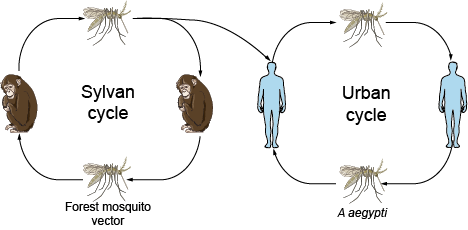 Figure 1. Transmission cycles of yellow fever.
The incubation period is 3–6 days. At the abrupt onset, the patient has fever, chills, headache, dizziness, myalgia, and backache followed by nausea, vomiting, and bradycardia (Figure 2). During this initial period, which lasts several days, the patient is viremic and a source of infection for mosquitoes. Most patients recover at this point, but in about 15% of cases, the disease progresses to a more severe form, with fever, jaundice, renal failure, and hemorrhagic manifestations. The vomitus may be black with altered blood. When the disease progresses to the severe stage (hepatorenal failure), the mortality rate is high (20% or higher), especially among young children and elderly adults. Death occurs on day 7–10 of illness. Encephalitis is rare. On the other hand, the infection may be so mild as to go unrecognized. Regardless of severity, there are no sequelae; patients either die or recover completely.
 Figure 2. Major symptom of yellow fever.
Yellow fever virus is a positive-sense, single-stranded, ribonucleic acid (RNA) ̶ enveloped flavivirus with a diameter of about 50-60 nm. The virus is transmitted via the saliva of an infected mosquito. Local replication of the virus takes place in the skin and regional lymph nodes. The virus gains entrance through receptor-mediated endocytosis. RNA synthesis occurs in the cytoplasm and protein synthesis takes place in the endoplasmic reticulum. Virions are released through the cell membrane.
See All Yellow Fever Viral Antigen Products
Yellow fever is difficult to diagnose, especially during the early stages. More severe disease can be confused with severe malaria, leptospirosis, viral hepatitis (especially fulminant forms), other hemorrhagic fevers, infection with other flaviviruses (e.g. dengue hemorrhagic fever), and poisoning. Blood tests (RT-PCR) can sometimes detect the virus in the early stages of the disease. In later stages of the disease, testing to identify antibodies is needed (ELISA and PRNT).
See All Yellow Fever Antibody and Yellow Fever ELISA Kit Products
Good and early supportive treatment in hospitals improves survival rates. There is currently no specific anti-viral drug for yellow fever but specific care to treat dehydration, liver and kidney failure, and fever improves outcomes. Associated bacterial infections can be treated with antibiotics.
Vaccination is the most important means of preventing yellow fever. Because yellow fever virus has only one single serotype, so it can be effectively prevent by vaccination. The yellow fever vaccine is safe and affordable and a single dose provides life-long protection against yellow fever disease. A booster dose of yellow fever vaccine is not needed.
The risk of yellow fever transmission in urban areas can be reduced by eliminating potential mosquito breeding sites by applying larvicides to water storage containers and other places where standing water collects. Insecticide spraying to kill adult mosquitoes during urban epidemics can help reduce the number of mosquitoes, thus reducing potential sources of yellow fever transmission.
References
Loading ......
