
Inquiry Basket
 Loading ......
The enzyme-linked immunosorbent assay (ELISA) is one of the most commonly used labeled immunoassay techniques. It is based on an enzyme-labeled antibody capable of detecting an antigen immobilized to a solid surface, 96-well or 384-well polystyrene plates. A substrate is added to produce either a color change or light signal correlating to the amount of the antigen which presents in the original sample. It is a simple and rapid technique to detect antibodies or antigens attached to a solid surface. Being one of the most sensitive immunoassays, ELISA offers commercial value in laboratory research, diagnostic of disease biomarkers and quality control in various industries.
According to the difference of the antigen immobilizing strategy, the antibody labeling strategy, and the type of antibody-antigen reaction (direct recognition or competition), ELISA can be presented in a variety of formats. Each has its own advantages and disadvantages. One can choose an optimal ELISA format flexibly according to the requirements.
This is the simplest form of ELISA (Figure 1). Here an antigen is attached passively to a plastic solid phase by a period of incubation. After a simple washing step, antigen is detected by the addition of an antibody that is linked covalently to an enzyme. After incubation and washing, the test is developed by the addition of a chromogen/substrate whereby enzyme activity produces a color change. Color development is read after a defined time or after enzyme activity is stopped by chemical means at a defined time. Color is read in a spectrophotometer.
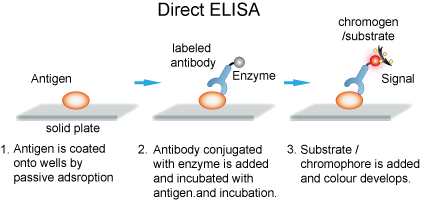 Figure 1. The flowchart of direct ELISA.
Direct ELISA is useful for qualitative or quantitative antigen detection in a sample, antibody screening, and epitope mapping since only one antibody is involved. There is no secondary antibody with cross-reactivity and the assay can be performed in less amount of time. However, the Immunoreactivity of the primary antibody might be adversely affected by labeling with enzymes. The labeled primary antibody is not commonly used, so labeling primary antibodies for each specific ELISA system is necessary when use direct ELISA.
The indirect detection method adds a labeled secondary antibody for detection on the basis of direct ELISA and it is the most popular ELISA format. Antigen is passively attached to wells by incubation. After washing, antibodies specific for the antigen are incubated with the antigen. Wells are washed and all bound antibodies are detected by the addition of anti-species antibodies covalently linked to an enzyme. Such antibodies are specific for the species in which the first antibody added were produced. After incubation and washing, the test is developed and can be read as described in figure 2.
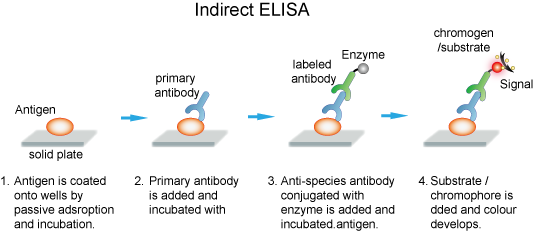 Figure 2. The flowchart of indirect ELISA
Similar to direct ELISA, indirect ELISA is useful for antibody screening, epitope mapping, and protein quantification. The secondary antibody serves to enhance the signal of the primary antibody, which makes it more sensitive than direct ELISA. However, it also produces a higher background signal and potentially decreases the overall signal.
Comparison of Direct and Indirect ELISA
| Advantages | Disadvantages | |
| Direct ELISA |
|
|
| Indirect ELISA |
|
|
The sandwich ELISA is one of the most useful immunoassay formats and it is designed for detection of soluble antigens. There are two forms of this ELISA depending on the number of antibodies used. The principle is the same for both instead of adding antigen directly to a solid phase, a capture antibody is immobilized to the solid phase to capture antigen.
For direct sandwich ELISA (figure 3a), capture antibody is attached on the solid phase. After washing away excess unbound antibody, antigen is added and is specifically captured. The antigen is then detected by a second enzyme labeled antibody directly against the antigen. This type of assay is useful where a single species antiserum is available and where antigen does not attach well to plates.
For indirect sandwich ELISA (figure 3b), the antigen is detected with a second unlabeled antibody. This antibody is in turn detected using an anti-species enzyme labeled conjugate. It is essential that the anti-species conjugate does not bind to the capture antibody, therefore the species in which the capture antibody is produced must be different. The same considerations about the need for that at least two antigenic sites allowing the “sandwich” are relevant. The advantage of this system is that a single anti-species conjugate can be used to evaluate the binding of antibodies from any number of samples.
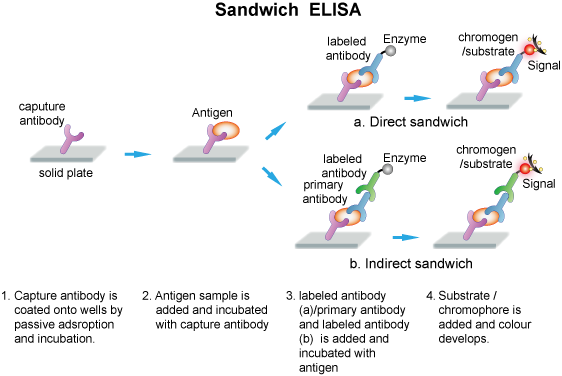 Figure 3. The flowchart of direct sandwich ELISA (a) and indirect sandwich ELISA (b)
These systems are useful when antigens are in a crude form (contaminated with other proteins) or at low concentration. In these cases the antigen cannot be attached directly to the solid phase at a high enough concentration to allow successful assay based on direct or indirect ELISAs. The sandwich ELISAs depend on antigens having at least two antigenic sites so that at least two antibody populations can bind.
The systems described above are the basic configurations of ELISA. All of these can be adapted to measure antigens or antibodies using competitive or inhibition conditions as described in figure 4.
Each assay described above requires pre-reaction of reagents to obtain optimal conditions. These optimal conditions are then challenged either by the addition of antigen (Figure 4a) or antibody (Figure 4b). As the amount of free antigen (antibody) in solution increases, the amount of antibody (antigen) that will bind to the immobilized substrate decreases. After washing step, chromophore substrate is added to generate signal (color change or light). The signal change caused by challenging with antibody/antigen reveals the information about the competitive antigen/antibody.
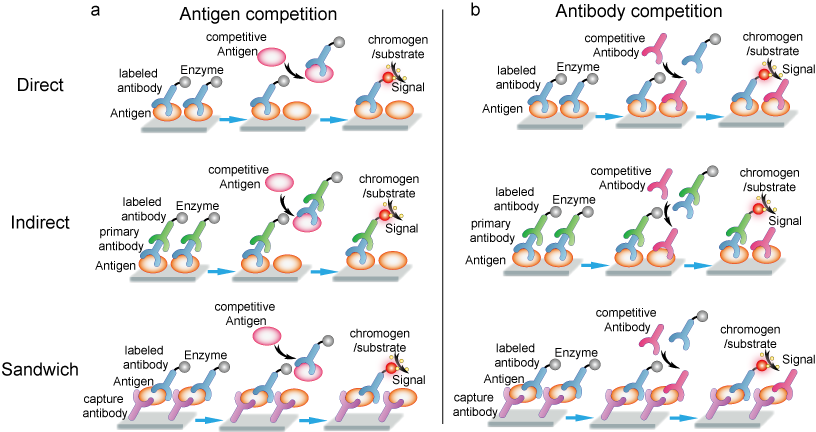 Figure 4. The flowchart of antigen competition ELISA (a) and antibody competition ELISA (b)
Competition ELISAs are particularly useful for measurements of antigen concentration in complex mixtures when the unknown samples that may contain antigen are compared to similar samples that contain known amounts of purified antigen.
In each case, the precise conditions should be optimized for a particular assay.
| Direct ELISA | Indirect ELISA | Sandwich/Capture ELISA |
Apply Antigen
Block Plate
Add Secondary Antibody Solution
Wash Plate
React Substrate
Recommended filters:
TMB-based substrates:
| Apply Antigen
Block Plate
React Primary Antibody
Wash Plate
Add Secondary Antibody Solution
React Substrate
| Apply Capture Antibody
Block Plate
React Sample Antigen
Wash Plate
Add Secondary Antibody Solution
React Substrate
|
References
Loading ......
